Searching for “TOPIK 1 preparation” can lead to long vocabulary lists and conflicting advice. Start by distinguishing the exam from the result: TOPIK I is the beginner test, and your score determines whether you receive Level 1 or Level 2. This guide concentrates on preparation; use our TOPIK dates and registration guide for planning, and confirm local arrangements with the official Indian organiser.
The eight-week plan below is our suggested framework, not an NIIED curriculum or a promised pass timeline. If you cannot yet read Hangul, allow extra foundation time. If you already study Korean, begin with a diagnostic set and spend longer on your weaker section. Your available study time and starting level matter more than the calendar.
Understand the TOPIK I paper before studying
For paper-based TOPIK I (PBT), listening has 30 questions over 40 minutes and reading has 40 questions over 60 minutes. Each section carries 100 marks, giving 200 marks overall. There is no writing section. Level 1 requires 80–139 marks; Level 2 requires 140–200. These are official PBT thresholds, not suggested targets.
TOPIK IBT is a separate computer-delivered format. Do not transfer the PBT timings, question counts or score bands to IBT. Check your booked test and try the official interface before selecting mock material. TOPIK I is also different from TOPIK II: a degree requiring Level 3 or above cannot be satisfied by a beginner TOPIK I result.
Find your starting point and set a manageable routine
If you can read Hangul, attempt a short unseen listening and reading set without a dictionary. Record your first-attempt answers and the time taken. If you cannot yet read the questions, start with the introductory course rather than scoring yourself on a full paper. The purpose is to identify what to learn, not to label yourself a weak student.
A suggested weekday session is 15 minutes reviewing vocabulary, 15 minutes studying one grammar pattern, 15 minutes listening and 15 minutes reading or reviewing errors. Shorten it when necessary, but retain both listening and reading across the week. Reserve a longer weekend session for practice and review. These durations are optional study suggestions, not evidence that a particular score can be achieved in a fixed number of hours.
An adjustable eight-week TOPIK I study plan
Move forward when the checkpoint is manageable. Repeating a week is more useful than rushing through material you cannot yet understand.
Week 1
Read Hangul before memorising answers
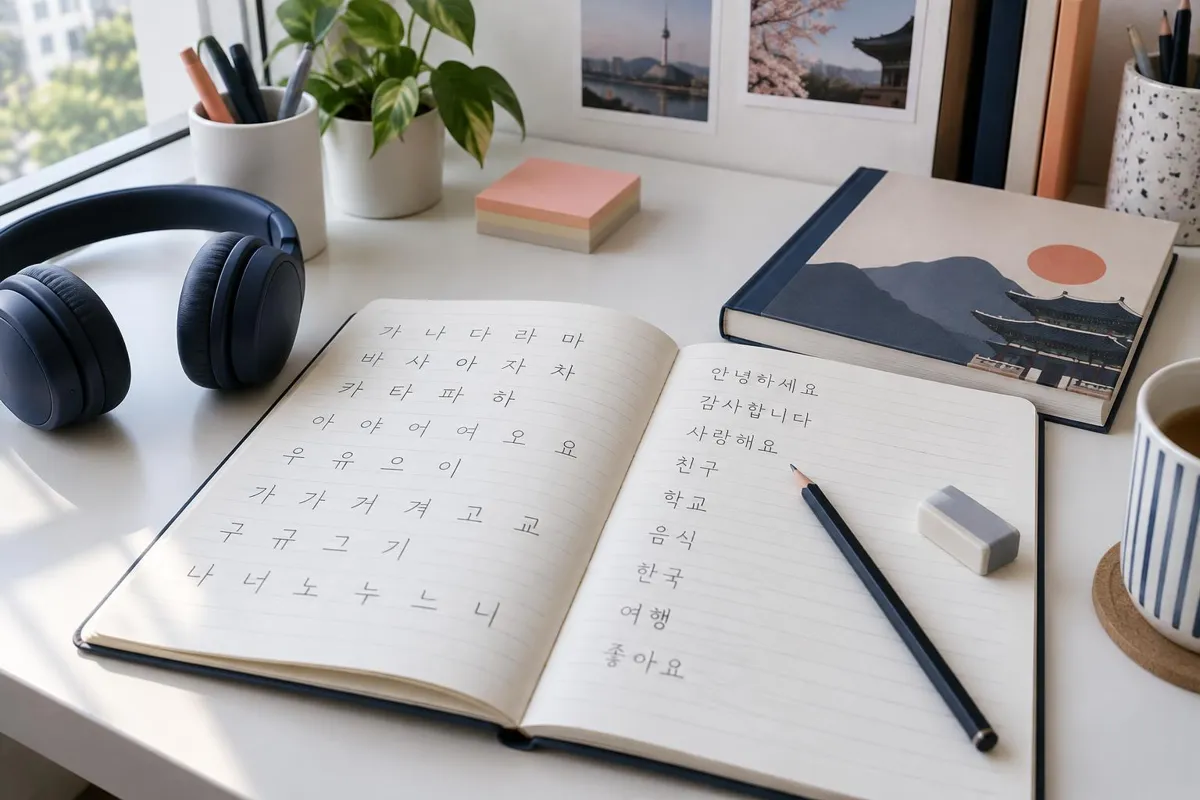
Work through an introductory Hangul course. Read syllables aloud, distinguish similar sounds and practise final consonants. Learn greetings and classroom expressions. Spend a short session looking at sample questions without expecting to understand everything.
Checkpoint: Read a short beginner dialogue without relying on Romanisation. If this is still difficult, repeat this week before moving on.
Week 2
Build everyday sentences
Study basic word order, polite present-tense endings and subject and object particles. Learn vocabulary for people, places and daily activities. Write your own simple sentences, then read and listen to a beginner dialogue containing the same patterns.
Checkpoint: Introduce yourself and identify who does what in a short sentence.
Week 3
Numbers, time and daily routines
Practise both Korean number systems in context: prices, dates, age and time. Add common verbs, past tense and simple location expressions. Listen to short exchanges about appointments or shopping; check the transcript only after your first attempt.
Checkpoint: Extract a price, time or destination from a short recording and explain the clue you heard.
Week 4
Begin question-by-question exam practice
Use an official TOPIK I paper or practice set. Work on a small group of listening and reading questions each day. First attempt them independently; then review the answer key. Identify whether each mistake came from vocabulary, grammar, sound recognition or misunderstanding the task.
Checkpoint: Complete a small practice set and explain why each correct answer fits, rather than simply remembering its letter.
Week 5
Strengthen listening comprehension
Practise identifying the speaker's purpose, place, topic and next action. Listen once under test-like conditions before replaying. Use the transcript to locate the missed expression, then listen again without reading it. Briefly repeat selected lines aloud to connect written words with their sound.
Checkpoint: Keep a record of what you understood on the first listen, separately from what became clear after replaying.
Week 6
Read for meaning and manage time
Practise signs, notices, short messages and everyday passages. Identify the question's demand before comparing options. Review common connectors, negation and tense clues. Time short sets, but prioritise understanding before trying to make every question faster.
Checkpoint: Finish a timed reading set and identify the exact phrase supporting each answer.
Week 7
Take a complete baseline mock
Choose an unseen paper matching your booked test format. For PBT, use the section timings below, play the listening audio without extra pauses and practise transferring answers. Mark it only after finishing. Compare listening and reading separately and prioritise recurring mistakes.
Checkpoint: Record the paper, date, section scores, unfinished questions and three specific actions for the following week.
Week 8
Review weaknesses and check readiness
Revisit your error log, practise the weakest question types and complete another unseen mock. Keep the final days manageable: revise familiar material and check the organiser's instructions, accepted identification and arrival time. Do not replace sleep with last-minute vocabulary cramming.
Checkpoint: Decide whether to sit the test, continue practising or adjust your target using fresh timed results—not a repeated paper's score.
Practise listening, reading and mistake review
Listening: separate testing from learning
During a mock, follow the recording as delivered and do not insert extra pauses. During review, replay deliberately: identify the key expression, read the transcript if available, and listen again without it. If an answer was correct only because you guessed, log it as a learning gap. Familiarity with a repeated recording is not the same as comprehension of a new conversation.
Reading: prove the answer from the passage
Look for evidence rather than matching one familiar word. A distractor can repeat vocabulary but contradict the time, person or action in the passage. Note negation, tense and connecting expressions. Practise manageable groups of questions before full timed papers, and avoid translating every sentence word for word when the task asks only for a main idea.
Keep a short error log
- Record the paper and question number, your answer and the correct answer.
- Classify the issue: unknown word, grammar, missed sound, misread task, timing or answer transfer.
- Write the exact clue you missed and one short example using it.
- Revisit the item later, then test the same skill on an unseen question.
Use two different unseen papers to compare progress. Keep section scores and unfinished questions alongside the total. A score above a published threshold in practice is encouraging, but it is not an official result and does not guarantee exam-day performance.
Free official preparation resources
- Official TOPIK practice material and score information
Use the organiser's material to understand question style and PBT level thresholds. Check which test format each resource covers and use its accompanying audio and answers where provided.
- Online King Sejong Institute curriculum
Choose introductory Hangul learning or beginner Korean courses such as Korean 1 and 2. These build language foundations; they are not identical to an exam-specific mock course. Registration and course availability may vary.
- Official TOPIK I IBT listening tutorial
If taking IBT, become familiar with the screen and controls. A tutorial demonstrates the interface; do not treat it as a complete scored readiness assessment.
Third-party material: TOPIK GUIDE is an independent practice provider, not NIIED or an official registration authority. If you use its papers or other community resources, check the test format and answer key, and distinguish free material from paid courses. No paid course is required to use the official resources above.
Plan the exam around your actual study goal
Before paying a registration fee, check the latest organiser's notice for the test type, venue, fee, identification rules and results date. Do not assume a global test calendar means every round is available in India. If a university application is your goal, confirm the department's required level and when evidence must be submitted. See the wider TOPIK exam guide, English-taught study pathways and GKS scholarship guidance for context; current official admission and scholarship notices take precedence.
Frequently asked questions
Can I prepare for TOPIK I in eight weeks from India?
Eight weeks can provide a useful study structure, but it does not guarantee Level 1 or Level 2. A complete beginner may need longer. Repeat weeks when necessary and judge readiness using unseen, timed practice papers.
Does TOPIK I include writing?
TOPIK I assesses listening and reading, not writing. Writing simple sentences can still help you learn grammar and vocabulary; it is a study technique, not a TOPIK I exam section.
What score is needed for TOPIK I Level 2?
For paper-based TOPIK I, Level 2 starts at 140 out of 200. Level 1 covers 80–139 out of 200. Do not apply these paper-based score bands or timings to IBT without checking the current official format.
Are free TOPIK preparation resources available?
Yes. The official TOPIK website provides practice material, and Online King Sejong Institute offers introductory and beginner Korean learning resources. Account registration may be needed for courses. Third-party practice websites are separate from the exam organiser.
Is TOPIK I enough for a Korean-taught degree?
TOPIK I certifies beginner Levels 1 and 2. A programme requiring Level 3 or above needs a TOPIK II result, not TOPIK I. Check the specific university and department's current admission rules; an exam score does not guarantee admission or a scholarship.
Official resources checked on 25 October 2026. This is an independent educational guide, not an official TOPIK announcement. Exam rules and local arrangements can change; verify them with NIIED and the relevant Indian organiser. Study checkpoints and routines are editorial suggestions, not score guarantees.